Let given points have the property that the line joining any two of them passes through a third point of the set. Must the points all lie on one line? This question was posed by Sylvester in his article “Mathematical question 11851” in 1893. The answer is no in general (complex projective plane), but on the ordinary plane the answer is yes. The paper by Coxeter, titled “A problem of Collinear points,” includes a geometric proof by L. M. Kelly. Additionally, the link provided features four sophisticated solutions, including Kelly’s own approach, and offers an intriguing historical perspective on the problem.
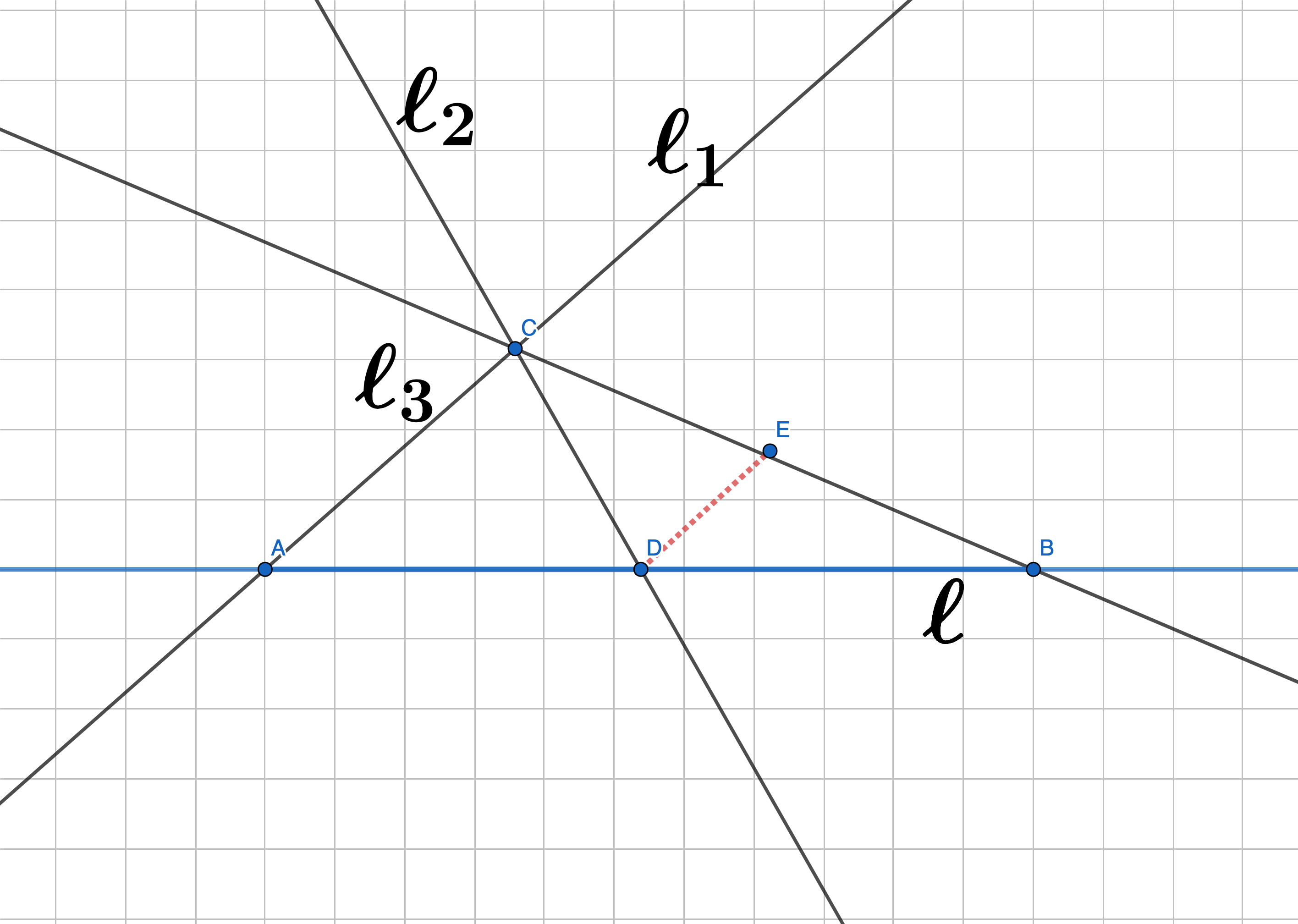
This post is about the corresponding dual problem that can be stated as follows: Consider a finite set consisting of lines, none of which are entirely parallel, and arranged such that a third line from passes through the intersection point of any two lines. Under these conditions, all the lines in must intersect at a single point. The proof is as follows. Let be lines in the set that intersect at point and let be another line that also passes through . For the sake of contradiction, let be a line that does not pass through . Since is finite, the number of such line intersection points that are not in is finite. Without any loss of generality, let’s assume that is the closest intersection point to . Let be the intersection points of the three lines with , and let be the middle point. By hypothesis another line needs to go through (red dotted line) that results in a point that contradicts the fact that was the closest such point to . This is illustrated in the figure below.


 tsourakakis.com