Few days ago I presented my recent paper on opinion dynamics and the wisdom of crowds at ECML-PKDD, joint work with two excellent PhD students at BU, Fabian Spaeh and Dragos Ristache.
Wisdom of Crowds
In 1906, approximately about 800 villagers participated in an event where they estimated the weight of an ox. Sir Francis Galton, a prominent scientist and statistician, analyzed the collective guesses of these villagers in a detailed study.

His analysis revealed a remarkable finding: the mean (543.5kg) and the median (548kg) of the estimates were extremely close to the actual weight of the ox (546kg). This outcome fascinated Galton because it demonstrated that the aggregate judgment of a diverse group could be incredibly accurate, even surpassing the guesses of an expert.
A plot that qualitatively illustrates this phenomenon follows: any non-expert will make a worse guess than the actual expert, but when a sufficient number of non-expert is combined, the crowd estimate becomes very good.

This phenomenon, now referred to as the “wisdom of crowds,” suggests that under certain conditions, the collective opinion of a group of individuals, especially when the group is diverse and the individuals are independent, can provide very accurate predictions. The wisdom of crowds has been observed in various contexts, such as decision-making, forecasting, and problem-solving. A book that discusses this phenomenon and its implications is by James Surowiecki; here is a talk by him discussing the power of the collective.
The concept has since been applied in numerous fields, including economics, psychology, and computer science, to harness the collective intelligence of groups. It underpins modern applications like predictive markets, crowd-sourced platforms, and collaborative filtering technologies. Studies continue to explore the parameters that optimize the accuracy of crowd wisdom, such as diversity of opinion, independence of members, decentralization, and aggregation of judgments. The enduring interest in this topic highlights its relevance and potential to enhance decision-making processes in both public and private sectors.
Asch’s experiments
Asch’s conformity experiments, conducted in the 1950s by psychologist Solomon Asch, are seminal studies in social psychology that explored the extent to which social pressure from a majority group could influence a person to conform. In these experiments, participants were placed in a group with actors who were instructed to provide incorrect answers to simple perceptual tasks, such as comparing the lengths of lines. Each participant was unaware that the others in the group were actors. When the actors unanimously chose incorrect answers, Asch found that a significant number of participants also provided incorrect responses, demonstrating the power of conformity to group norms. The experiments highlighted how individuals often conform to group opinion even against their own judgment, shedding light on the dynamics of group pressure and individual independence.
Motivation
Our paper, “Wiser than the Wisest of Crowds: The Asch Effect and Polarization Revisited,” is motivated by exploring the interplay of the Asch effect and the wisdom of crowds within an opinion dynamics model set in a social network. In our setting, we consider a group of 


Vilnius
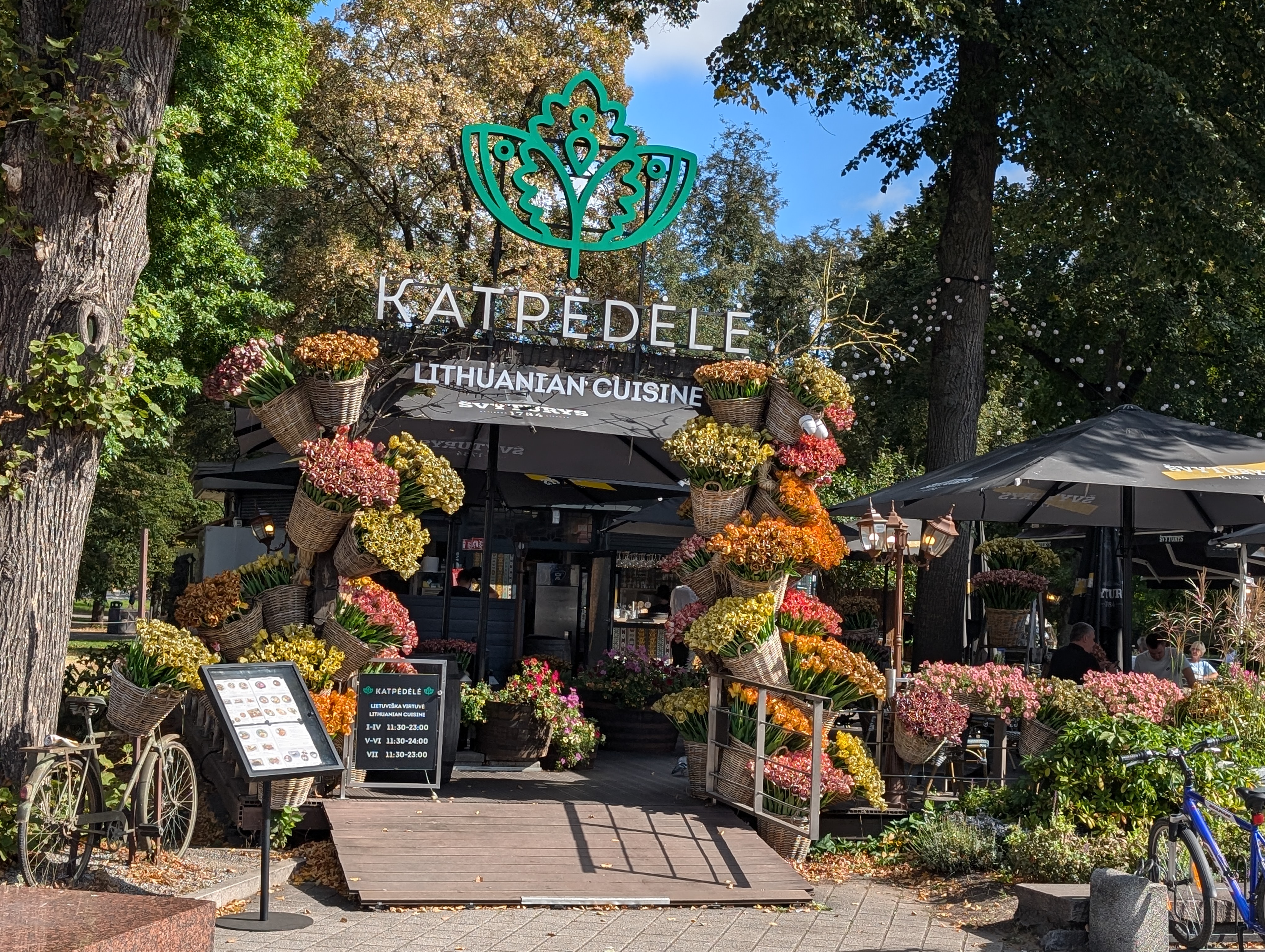
On a different note, I had never visited Vilnius before, and as some locals described it, the city is “unexpectedly amazing.”


 tsourakakis.com